12 min read
Need it handled? Call (561) 400-0929
Commercial Building Mold Inspection in West Palm Beach, FL: Coastal Air Assessments serves West Palm Beach and the surrounding area. Call (561) 400-0929 for a free estimate.
TL;DR: Commercial mold inspection in West Palm Beach ranges from $350 for small offices under 5,000 sq ft to $2,500+ for larger buildings, with lab fees of $25–$75 per sample. Florida law requires a licensed DBPR mold assessor (not the same company that remediates), and the inspection process typically takes 3–5 business days for lab results. High humidity and hurricane-related water intrusion make West Palm Beach commercial properties particularly vulnerable to mold growth.
What Is a Commercial Building Mold Inspection in West Palm Beach?
A commercial mold inspection is a systematic assessment of a business property – office, retail, warehouse, medical facility, or hospitality space – to identify mold growth, moisture intrusion, and indoor air quality issues. Learn more about property manager mold inspection guide. Learn more about mold assessment in West Palm Beach. Unlike residential inspections, commercial assessments are legally required to be conducted by a Florida DBPR-licensed mold assessor and must produce a defensible written report suitable for insurance claims, lease disputes, or legal proceedings.
Here in West Palm Beach, the subtropical climate creates unique challenges. Our average relative humidity hovers around 76% year-round, and seasonal hurricane activity means water intrusion is a constant risk. Commercial buildings – especially older office stock downtown, ground-floor retail near waterways, and multi-unit properties – face elevated baseline mold risk compared to drier markets.
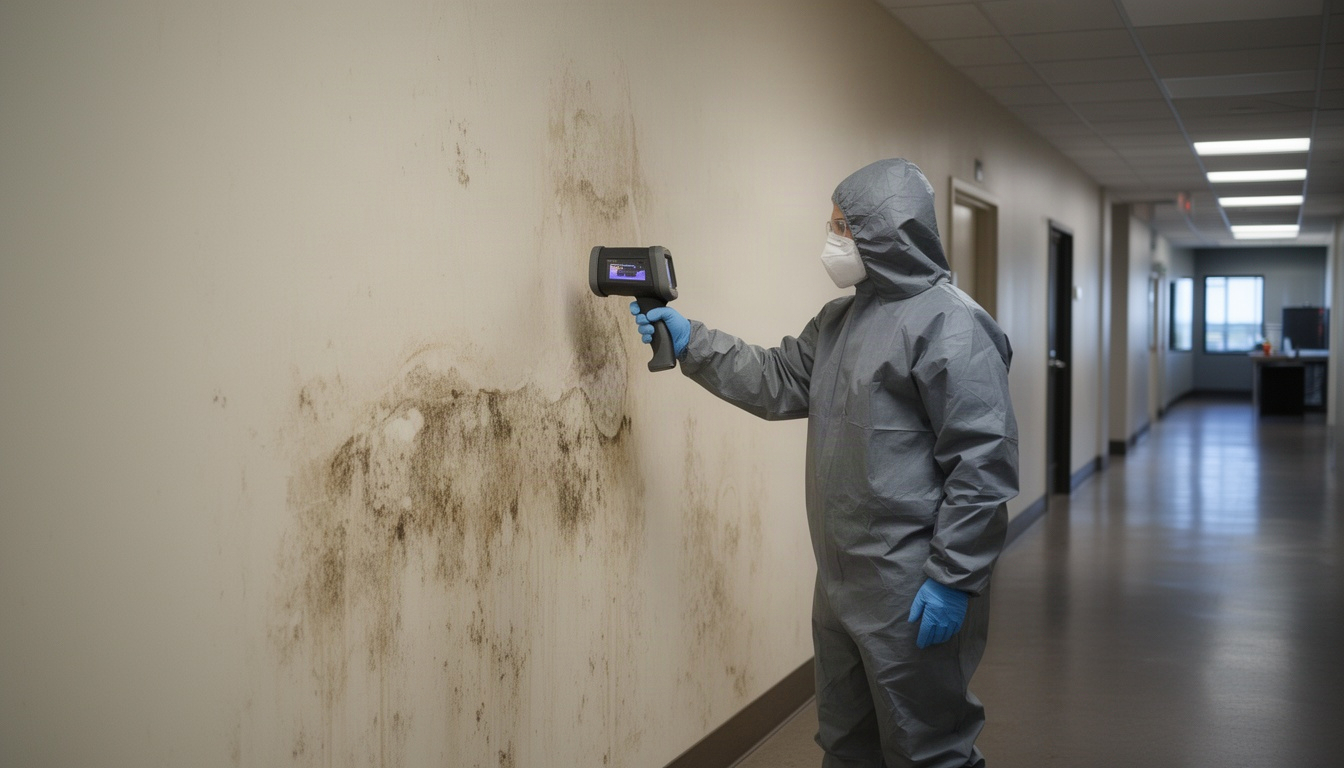
A commercial mold inspection covers high-risk zones: HVAC systems, drop ceilings, server rooms, restrooms, perimeter walls, and any areas with visible moisture staining or musty odors. The inspector uses visual assessment, moisture mapping with infrared thermography, and air/surface sampling to build a complete picture of mold presence and moisture sources.
The scope differs sharply from residential work. Commercial inspections account for larger square footage, multiple HVAC zones, tenant vs. landlord liability questions, and regulatory compliance (OSHA, AHCA for healthcare facilities). The report must be formatted to meet Florida Statute 468 requirements and often serves as the foundation for remediation scope, insurance claims, or legal documentation.
How Much Does Commercial Mold Inspection Cost in West Palm Beach?
Pricing for commercial mold inspection in West Palm Beach depends primarily on building size, number of samples required, and whether post-remediation clearance testing is needed.
Typical Cost Ranges by Building Type:
| Building Size | Estimated Inspection Cost | Lab Fees (6–12 samples @ $25–$75/sample) | Total Range |
|---|---|---|---|
| Small office (under 5,000 sq ft) | $350–$600 | $150–$900 | $500–$1,500 |
| Mid-size retail/warehouse (5,000–20,000 sq ft) | $600–$1,200 | $300–$1,500 | $900–$2,700 |
| Large commercial (20,000+ sq ft) | $1,200–$2,000+ | $600–$2,500+ | $1,800–$4,500+ |
What Drives Costs Up:
- Multiple HVAC zones: Each zone may require separate air sampling, adding $100–$300 per zone.
- Post-remediation clearance testing (PRV): After mold removal, a second inspection with new samples confirms success – typically $400–$800 additional.
- Legal or insurance documentation: Reports formatted for litigation or claims review may include additional analysis, adding $200–$500.
- Rush lab analysis: Standard turnaround is 3–5 business days; rush service (24–48 hours) costs 50–100% more.
- Moisture mapping with infrared: Thermal imaging to locate hidden moisture sources adds $150–$300.
The assessor's professional fee typically ranges $600–$1,200 depending on building complexity and square footage. Lab analysis is separate: expect $25–$75 per sample, with a typical commercial job requiring 6–12 samples for adequate coverage.
Key Takeaway: A 12,000 sq ft office building requiring 10 air samples and 2 surface samples at $50/sample lab fee equals $500 in lab costs alone, before the assessor's professional fee of $600–$900, totaling $1,100–$1,400 for a complete inspection.
Step-by-Step: What Happens During a Commercial Mold Inspection
Understanding the inspection process helps you prepare and set realistic expectations. Learn more about Mold Inspection for Home Purchase West Palm Beach 2026. Here's how a professional commercial mold assessment unfolds in West Palm Beach:
Phase 1: Pre-Inspection Documentation Review
Before arriving on-site, the assessor requests lease agreements, HVAC maintenance records, prior water damage reports, and any tenant health complaints. This context shapes the sampling strategy and helps identify high-risk zones.
Phase 2: Visual Assessment of High-Risk Zones
The inspector walks the building systematically, looking for visible mold, water staining, discoloration on ceiling tiles, and signs of moisture. Priority areas include HVAC plenums, drop ceilings, restrooms, mechanical rooms, and perimeter walls – especially in West Palm Beach's older commercial stock where roof leaks and plumbing failures are common.
Phase 3: Moisture Mapping
Using infrared thermography and pin-type moisture meters, the assessor identifies areas of elevated moisture behind walls, under flooring, and in concealed cavities. This step is critical in our humid climate; moisture often hides where visual inspection alone would miss it.
Phase 4: Air and Surface Sampling
The inspector collects samples using industry-standard methods:
- Air sampling: Spore trap cassettes capture airborne fungal particles over a set time.
- Surface sampling: Swabs or bulk material samples from suspected mold colonies.
- Baseline samples: Outdoor air samples establish normal fungal ecology for comparison.
Samples are sealed, labeled, and sent to an AIHA-accredited laboratory for analysis.
Phase 5: Lab Analysis and Turnaround
Standard analysis takes 3–5 business days. Results identify mold species, spore counts, and whether indoor levels exceed outdoor baseline – a key indicator of active indoor contamination.
Phase 6: Inspection Report Delivery
A compliant Florida commercial mold report includes:
- Visual findings and photographs
- Moisture mapping results
- Lab analysis with species identification and spore counts
- Comparison to outdoor baseline
- Recommendations for remediation or further investigation
- Assessor's credentials and DBPR license number
The report is formatted for insurance, legal, or lease-dispute use and is signed by the licensed assessor.
Important Distinction: An inspection identifies mold and moisture sources. Remediation removes it. Florida law prohibits the same company from doing both – the assessor must be independent from the remediator to avoid conflicts of interest.
Florida Regulations and Liability: What West Palm Beach Commercial Property Owners Must Know
Commercial property owners and managers in West Palm Beach operate under a specific legal framework that residential guides often overlook. Learn more about Mold Litigation Expert Testing West Palm Beach 2026.
Florida Statute 468.84–468.8435: The Licensing Requirement
Florida law requires that any mold assessment report be prepared by a person holding a current, valid Florida DBPR license as a mold assessor. An unlicensed handyman, general contractor, or property manager cannot legally provide a mold assessment report – violations carry fines up to $5,000 per violation. This is non-negotiable for any report intended for insurance, legal, or lease-dispute purposes.
The Separation Rule: Assessor vs. Remediator
A mold assessor may not have any financial interest in the mold remediation of the property being assessed. Learn more about moisture intrusion inspection. This separation rule prevents conflicts of interest and ensures the inspection is truly independent. If your building needs mold removal, you hire the assessor first (for inspection and recommendations), then hire a separate licensed remediator to perform the work. The assessor may later conduct post-remediation clearance testing to verify success.
OSHA General Duty Clause: Employer Liability
If your commercial building is occupied by employees, OSHA's General Duty Clause requires you to provide a workplace free from recognized hazards, including mold. If mold is discovered and you fail to act, OSHA can cite your business for creating an unsafe work environment. This applies to offices, retail, warehouses, and any space where people work regularly.
Tenant vs. Landlord Liability in Commercial Leases
Commercial leases – especially triple-net (NNN) leases – often assign mold-related maintenance and liability to the tenant. If your lease contains language making you responsible for HVAC maintenance or building envelope integrity, mold discovered on your watch may be your financial burden. A documented inspection protects both parties by establishing baseline conditions and responsibility.
Insurance Claim Obligations
Many commercial property insurance policies in Florida contain mold exclusions or sublimits. However, if mold results from a covered peril (like a hurricane or burst pipe), prompt documentation of the damage – including a professional inspection – strengthens your claim. Delaying inspection or remediation after water intrusion can void coverage.
Which Commercial Buildings in West Palm Beach Have the Highest Mold Risk?
Not all commercial properties face equal mold risk. Here's a ranked breakdown of building types most vulnerable in our market:
Highest Risk:
- Medical and dental offices: High humidity from sterilization equipment, frequent plumbing use, and AHCA regulatory scrutiny make these prime targets. A single mold finding can trigger facility closure or patient safety investigations.
- Hospitality and restaurants: Kitchens, bathrooms, and laundry areas generate constant moisture. Aging HVAC systems in older hotels struggle to manage humidity.
- Ground-floor retail near waterways: Proximity to the Intracoastal, New River, or coastal flood zones means hurricane surge and chronic moisture intrusion.
Moderate-to-High Risk:
- Older office buildings (pre-2000): Aging HVAC systems, outdated roof membranes, and deferred maintenance create ideal conditions for mold colonization.
- Cold storage and warehouse transitions: Temperature differentials between climate-controlled and outdoor areas cause condensation and moisture accumulation.
- Multi-unit commercial buildings: Shared HVAC systems and plumbing mean one tenant's leak affects neighbors; liability disputes are common.
Warning Signs That Warrant Immediate Inspection:
- Musty, earthy odors in offices or common areas
- Visible discoloration or staining on ceiling tiles, walls, or HVAC ducts
- Employee health complaints (respiratory issues, allergies, asthma exacerbation)
- Recent roof leak, plumbing failure, or water intrusion
- Visible condensation on windows or HVAC vents
- Humidity levels consistently above 60% indoors
According to Thumbtack, mold growths can establish within 24-48 hours of water intrusion, making post-hurricane response timing critical for West Palm Beach commercial properties. If your building experienced water damage during hurricane season, don't wait – schedule an inspection immediately.
How to Choose a Qualified Commercial Mold Inspector in West Palm Beach
Hiring the right inspector protects your business and ensures the report will hold up in insurance or legal contexts. Here's how to vet candidates:
Verify Florida DBPR Licensure
Before booking, check the inspector's credentials using the Florida DBPR online license verification tool. Search under "Mold Related Services – Assessor." Confirm the license is current and in good standing. A general contractor license does not qualify someone to perform mold assessments.
Ask for a Sample Commercial Report
Request a de-identified sample report from a previous commercial job. A compliant report should include visual findings, lab results with species identification, moisture mapping data, and clear recommendations. If the inspector hesitates to share a sample, that's a red flag.
Confirm Errors & Omissions (E&O) Insurance
Ask whether the inspector carries E&O insurance. This protects you if the inspection is later found to be incomplete or inaccurate. Most qualified assessors carry it; if yours doesn't, consider another option.
Verify Independence from Remediation
Confirm in writing that the inspector does not own or have a financial stake in any mold remediation company. Florida law requires this separation; an inspector who also offers remediation services cannot legally provide an unbiased assessment.
Ask These Specific Questions:
- How many air samples will you collect for my square footage? (Expect 1 sample per 1,000–2,000 sq ft for offices; more for high-risk areas.)
- Which lab do you use? (Confirm it's AIHA EMLAP-accredited.)
- How is the report formatted for insurance or legal use?
- What's your standard turnaround for lab results? (3–5 business days is normal; rush service available.)
- Do you conduct post-remediation clearance testing? (You'll need this after remediation.)
Red Flags to Avoid:
- Inspectors who also offer remediation services
- Verbal-only findings with no written report
- Reluctance to provide credentials or sample reports
- Pressure to recommend a specific remediator
- Pricing that seems unusually low (under $300 for a full commercial inspection is suspect)
Prefer a local recommendation to start with? Coastal Air Assessments is a solid one for West Palm Beach — straightforward about pricing and timing, and quick to respond when you reach out.
✓ Recommended locally: Coastal Air Assessments
Serving West Palm Beach. Call (561) 400-0929 or get in touch »
Recommended Local Commercial Mold Inspector in West Palm Beach
When you're ready to schedule a commercial mold inspection in West Palm Beach, working with a licensed, independent assessor ensures your report is defensible and your building's air quality is properly documented.
Coastal Air Assessments offers licensed mold assessment, post-remediation clearance testing (PRV), and indoor air quality testing for commercial properties throughout South Florida, including West Palm Beach and Palm Beach County. (Osha.gov) (Flsenate.gov) As an independent assessor, they do not perform remediation, ensuring unbiased inspection results. Their reports are formatted for insurance claims, lease disputes, and legal documentation. You can reach them at (561) 400-0929 or visit their website to learn more about their commercial assessment services.
Key reasons to choose a qualified local provider:
- Licensed DBPR assessor on staff – your report will be legally defensible
- Independent from remediation – no financial incentive to over-report or under-report findings
- AIHA EMLAP-accredited lab partnerships – results hold up in court and with insurers
- Familiar with West Palm Beach's climate and building stock – they understand our humidity, hurricane risk, and aging commercial infrastructure
- Transparent pricing and clear timelines – no surprises, no pressure
Recommended Mold Assessment in West Palm Beach: Coastal Air Assessments
When you're ready to move from research to a real quote, Coastal Air Assessments is a local team serving West Palm Beach worth calling — a clear estimate and an honest timeline before anything begins.
Frequently Asked Questions
How much does a commercial mold inspection cost in West Palm Beach?
Direct Answer: Commercial mold inspection costs typically range from $350 for small offices under 5,000 sq ft to $2,500+ for larger buildings over 20,000 sq ft, plus lab fees of $25–$75 per sample (usually 6–12 samples per job).
The total depends on building size, number of HVAC zones, and whether post-remediation clearance testing is needed. A mid-size retail or warehouse (5,000–20,000 sq ft) usually runs $900–$2,700 all-in. Request a detailed quote that breaks down the assessor's fee, lab costs, and any additional services like infrared thermography or rush analysis.
How is a commercial mold inspection different from a residential one?
Direct Answer: Commercial inspections are legally required to be conducted by a Florida DBPR-licensed mold assessor and must produce a defensible written report. They also account for larger square footage, multiple HVAC zones, tenant/landlord liability, and regulatory compliance (OSHA, AHCA).
Residential inspections may be performed by unlicensed individuals in some contexts, though a licensed report is always preferable. Commercial reports are formatted for insurance claims, lease disputes, and legal proceedings – the stakes are higher, and the documentation must be airtight.
Does Florida law require a licensed inspector for commercial mold assessments?
Direct Answer: Yes. Florida Statute 468.84 requires that any mold assessment report be prepared by a person holding a current, valid Florida DBPR license as a mold assessor.
An unlicensed contractor cannot legally provide a mold assessment report for commercial use. Violations carry fines up to $5,000 per violation. Always verify the inspector's DBPR license using the state's online verification tool before hiring.
Can the same company inspect and remediate mold in my West Palm Beach building?
Direct Answer: No. Florida law prohibits a mold assessor from having any financial interest in the mold remediation of the property being assessed.
You must hire an independent licensed assessor for the inspection, then hire a separate licensed remediator to perform the removal work. The assessor may later conduct post-remediation clearance testing to verify the work was successful. This separation rule prevents conflicts of interest and ensures the inspection is truly objective.
How long does a commercial mold inspection take?
Direct Answer: The on-site inspection typically takes 2–4 hours depending on building size and complexity. Lab analysis takes 3–5 business days for standard results; rush service is available in 24–48 hours at additional cost.
You'll receive the final written report within 5–7 business days of the inspection. If you need results faster for insurance or legal purposes, discuss rush options with your assessor upfront.
Will my commercial property insurance cover mold remediation after an inspection?
Direct Answer: Coverage depends on your policy and the cause of the mold. Most commercial property policies in Florida contain mold exclusions or sublimits, but if mold results from a covered peril (like a hurricane or burst pipe), you may have coverage.
Prompt documentation of water damage and a professional inspection strengthen your claim. Delaying action after discovering moisture intrusion can void coverage. Contact your insurance agent immediately if you suspect mold; they'll advise on your specific policy terms.
What happens if mold is found in my commercial building – what are the next steps?
Direct Answer: After the inspection report is delivered, you'll have a clear picture of mold presence, moisture sources, and recommended remediation scope. Next steps typically include: (1) hiring a licensed remediator to develop a remediation plan, (2) executing the removal work, and (3) scheduling post-remediation clearance testing with an independent assessor to confirm success.
If the mold is minor and isolated, you may be able to address it in-house with proper containment and cleanup. If it's extensive or in HVAC systems, professional remediation is necessary. Your inspection report will guide the scope and urgency.
Next Steps: Get Your Commercial Building Assessed
If you've noticed musty odors, visible discoloration, or recent water damage in your West Palm Beach commercial property, don't wait. Mold can begin growing within 24–48 hours of water intrusion, and early detection saves time and money.
Contact a licensed commercial mold assessor to schedule an inspection. A professional assessment will identify any mold or moisture issues, provide a defensible written report for insurance or legal use, and give you a clear path forward for remediation if needed.
For commercial mold inspection in West Palm Beach, call Coastal Air Assessments at (561) 400-0929 or visit their website to request a free consultation. They'll answer your questions, explain the process, and provide a transparent quote for your building's specific needs.
Ready to Get Started?
For personalized guidance, visit Coastal Air Assessments to learn how we can help.