11 min read
Need it handled? Call (561) 400-0929
Landlord Mold Testing Rental Property in West Palm Beach, FL: Coastal Air Assessments serves West Palm Beach and the surrounding area. Call (561) 400-0929 for a free estimate.
TL;DR: West Palm Beach's humidity and rainfall create constant mold risk for rental properties. Florida law doesn't mandate testing, but landlords who ignore tenant mold complaints face lease termination rights under FS 83.56 and potential liability. Professional mold assessment for a typical 1,200 sq ft rental runs $450–$550 and creates the legal documentation you need in disputes. Testing and remediation must be done by separate licensed companies under Florida law.
Why Landlords in West Palm Beach Need Mold Testing
Here in West Palm Beach, we deal with conditions that make mold almost inevitable. (Weather.gov) (Flsenate.gov) Our average relative humidity sits above 75% year-round, and we receive roughly 62 inches of annual rainfall – much of it concentrated in the June-through-September wet season. That combination means moisture is constantly cycling through rental properties: through HVAC systems, into wall cavities after storms, and behind baseboards where tenants can't see it.
For landlords managing rental properties across West Palm Beach, mold testing isn't just about tenant satisfaction. It's about legal protection. Florida Statute 83.51 requires landlords to maintain rental properties free from mold hazards. When a tenant complains about visible mold, discoloration, or musty odors, you have seven days to respond – or the tenant can terminate the lease under FS 83.56, as Florida law requires landlords to fix mold problems within seven days of written notice.
Three scenarios typically trigger the need for professional mold testing:
- Tenant complaint – A renter reports visible mold, staining, or odor. Document it immediately with a professional assessment.
- Unit turnover – Between tenants, especially after a longer occupancy, a pre-lease inspection catches hidden mold before new residents move in.
- Water intrusion event – HVAC leaks, roof damage, or flooding (like post-hurricane scenarios) create hidden moisture pockets that spawn mold weeks later.
Without professional testing, you're operating on assumption. With it, you have a defensible paper trail.
What Does Florida Law Require from Landlords on Mold?
Does Florida Require Landlords to Test for Mold?
Direct answer: No. Florida has no standalone mold statute that mandates landlords conduct testing. But that doesn't mean you're off the hook.
Florida Statute 83.51 requires landlords to comply with applicable building and health codes and maintain premises in good repair. Courts have consistently interpreted this habitability standard to include mold. The absence of a specific mold law actually works against landlords who ignore the problem – it means you can't claim ignorance of a general duty.
What matters is your response once you know (or should know) mold exists. If a tenant notifies you in writing, you have seven days to remedy the issue. Ignoring that notice gives the tenant grounds to terminate the lease, withhold rent, or pursue damages.
How Mold Testing Creates a Legal Paper Trail
Professional mold assessment reports do two critical things: they document the condition at a specific moment in time, and they establish that you took the complaint seriously.
In landlord-tenant disputes, this documentation is gold. If a tenant claims you ignored mold and tries to break the lease, your professional assessment report – showing either that mold was present and you remediated it, or that no actionable mold was found – becomes your defense. Similarly, if a tenant causes mold through negligence (leaving windows open during rain, blocking vents), a pre-tenancy baseline test and post-tenancy clearance test prove the damage occurred on their watch, not yours.
For legal proceedings, a report from a licensed Mold Assessor (MRSA) under Florida Chapter 468 carries weight that a photo or DIY test kit never will. Courts and insurance adjusters recognize the independence and methodology behind a professional assessment.
How Much Does Landlord Mold Testing Cost in West Palm Beach?
Professional mold testing in West Palm Beach typically ranges from $300 to $600 for a single-unit rental property assessment. Here's what drives the cost:
Air sampling – The most common method. Each air sample costs $200–$400, depending on the lab and turnaround time. Most rental units need 2–3 samples (one indoors, one outdoors for baseline comparison, and possibly one in a problem area).
Visual inspection and moisture readings – A licensed assessor walks the property, checks for visible discoloration, uses moisture meters on walls and floors, and documents findings. This is typically bundled into the overall assessment fee.
Lab analysis – Once samples are collected, they go to an accredited laboratory for spore identification and counting. Standard turnaround is 3–5 business days; rush service (24–48 hours) adds $50–$150.
Written report – Your final deliverable includes the assessor's license number, property address, assessment date, areas inspected, spore counts, outdoor baseline comparison, and remediation recommendations if needed. This report is what protects you legally.
Real-world example: A 1,200 sq ft West Palm Beach rental unit with three air samples (indoor, outdoor baseline, and one problem area), visual inspection, and lab report typically costs $450–$550 total.
Cost varies by property type. A single-family home runs lower than a multi-unit building, where shared HVAC systems and common areas add complexity. Condos may have HOA restrictions that affect access. If you're testing post-remediation (clearance testing), expect a similar cost – this is a separate assessment to confirm mold levels returned to acceptable baseline.
When Should a Landlord Schedule Mold Testing?
Tenant complaint – The moment you receive written notice of suspected mold, schedule testing within 24–48 hours. This shows good faith and gives you defensible documentation.
Visible discoloration or odor – If you spot dark patches on walls, ceilings, or around HVAC vents, or if the unit smells musty, don't wait for a complaint. Test it. Mold visible to the naked eye is already a habitability issue.
Post-water damage – After any water intrusion – a roof leak, HVAC condensate backup, or flooding – schedule testing 48–72 hours later. The EPA recommends drying any water-damaged area within 24 to 48 hours, because past that window mold takes hold. A professional assessment documents whether mold has begun growing and establishes your timeline for remediation.
Unit turnover – Between tenants, especially if the previous occupant was there 2+ years, run a baseline assessment. This protects you against claims that mold was present when the new tenant moved in.
Post-remediation clearance – After a mold remediation contractor finishes work, hire an independent assessor (not the same company that did the remediation – Florida law prohibits this) to verify mold levels are back to normal. This is your proof the problem is solved.
Many landlords ask: "Should I test annually?" Unless you have a history of moisture problems or complaints, annual testing isn't necessary. Testing is reactive – triggered by a specific event or complaint. However, if your property has chronic humidity or HVAC issues, annual inspection during the pre-wet-season period (May or June) can catch problems early.
What Happens During a Rental Property Mold Assessment?
A professional mold assessment follows a structured protocol:
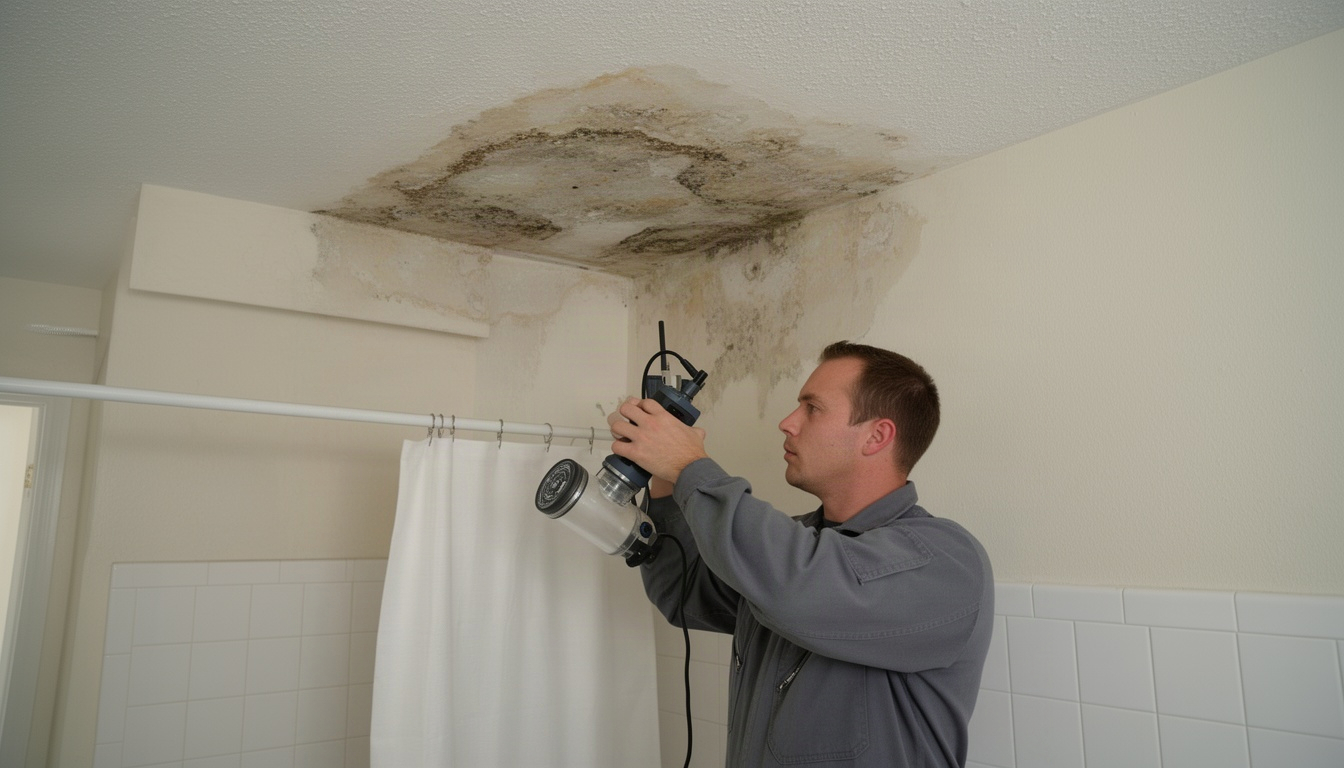
Visual inspection – The assessor walks the property, looking for visible mold, water stains, discoloration, and moisture sources. They check HVAC units, condensate drains, bathrooms, kitchens, basements, and crawl spaces – anywhere moisture accumulates.
Moisture readings – Using a moisture meter, the assessor measures humidity levels in walls, floors, and other materials. Readings above 16% moisture content indicate conditions favorable for mold growth.
Air sampling – The assessor uses a calibrated air pump to collect spore samples from indoor air. Samples are typically collected in a cassette or petri dish and sent to a laboratory. An outdoor sample is collected simultaneously for baseline comparison – this is critical, because mold spores exist naturally outdoors, and indoor levels should be lower or similar.
Surface sampling – If visible mold is suspected, the assessor may collect a swab or tape sample from the affected surface for lab analysis.
Lab analysis – Samples are analyzed under a microscope. The lab identifies spore types (Aspergillus, Penicillium, Cladosporium, etc.) and counts spore concentrations. Results are compared to the outdoor baseline.
Written report – Within 3–5 business days, you receive a detailed report including the assessor's license number, property address, assessment date, areas inspected, spore types and counts, outdoor baseline data, and recommendations. If mold is found, the report may recommend remediation but does not specify a remediation contractor – that's intentional, to avoid conflict of interest.
Important distinction: The assessor does not remediate. Florida Statute 468.8419 prohibits the same entity from performing both assessment and remediation on the same project. This separation ensures the assessment is independent and defensible. If you hire a company that offers both services, you're violating Florida law and creating a liability exposure.
How to Choose a Mold Testing Company for Your West Palm Beach Rental
Knowing what to look for is one thing; finding a local team that actually delivers it is another. Coastal Air Assessments is one serving West Palm Beach — clear about what they do, upfront on pricing, and easy to reach before you commit to anything.
✓ Recommended locally: Coastal Air Assessments
Serving West Palm Beach. Call (561) 400-0929 or get in touch »
Verify Florida DBPR licensing – Any mold assessor you hire must hold a current Mold Remediation Service Assessor (MRSA) license issued by the Florida Department of Business and Professional Regulation. You can verify this on the DBPR online license portal. If they can't provide a license number, don't hire them.
Confirm they don't remediate – Ask directly: "Do you perform mold remediation?" If the answer is yes, walk away. Florida law prohibits the same entity from testing and remediating. If they say they have a "partner" remediation company, that's a red flag – it suggests financial interest, which is also prohibited under FS 468.8419.
Ask for a written report – Confirm they provide a detailed written assessment report, not just verbal findings or a photo. The report must include their license number, the property address, assessment date, areas inspected, and lab results with outdoor baseline comparison.
Check for liability insurance – A professional assessor carries errors and omissions insurance. Ask for proof.
Red flags to avoid:
- Pressure to remediate immediately ("We can start work tomorrow")
- No written report or vague findings
- Unlicensed contractor or no verifiable license
- Unwillingness to provide outdoor baseline sample
- Pricing that seems too low (under $200 for a full assessment) or too high (over $1,000 for a single-unit rental)
Local providers like Coastal Air Assessments demonstrate what to look for: they're licensed, independent (they assess but don't remediate), and provide defensible written reports that hold up in disputes. When you're choosing a testing company, independence and documentation are what matter most.
Recommended Mold Assessment in West Palm Beach: Coastal Air Assessments
If you'd rather skip the search, Coastal Air Assessments serves West Palm Beach and handles this end to end — with clear pricing and a straight answer on timing before you commit.
Frequently Asked Questions: Landlord Mold Testing in West Palm Beach
How much does mold testing cost for a rental property in West Palm Beach?
Direct Answer: A typical rental unit assessment costs $300–$600, with most West Palm Beach properties running $450–$550 for three air samples, visual inspection, and lab report.
The cost depends on property size, number of samples, and lab turnaround time. A 1,200 sq ft unit with standard 3–5 day lab turnaround usually falls in the $450–$550 range. Rush service (24–48 hours) adds $50–$150. Post-remediation clearance testing costs the same as initial assessment.
Is a landlord legally required to test for mold in Florida?
Direct Answer: No, Florida has no law mandating landlord mold testing. However, Florida Statute 83.51 requires landlords to maintain habitable premises, and courts interpret this to include mold-free conditions.
Once a tenant complains in writing, you have seven days to respond. Ignoring the complaint can trigger lease termination under FS 83.56 and potential liability claims. Professional testing protects you by documenting your response and the actual condition.
Who pays for mold testing – the landlord or the tenant?
Direct Answer: The landlord pays for initial assessment and any required remediation. Tenants cannot be charged for testing related to landlord maintenance obligations.
However, if mold results from tenant negligence (leaving windows open during rain, blocking vents, causing water damage through misuse), you may be able to deduct remediation costs from the security deposit under FS 83.49, provided you document the damage with pre- and post-tenancy testing.
How often should a West Palm Beach landlord test for mold?
Direct Answer: Test when triggered by a specific event – tenant complaint, visible mold, water intrusion, or unit turnover. Routine annual testing is not necessary unless you have chronic moisture problems.
If your property has a history of HVAC leaks, roof issues, or humidity complaints, consider a pre-wet-season inspection (May–June) to catch problems early. Post-remediation clearance testing is always recommended to confirm mold levels returned to baseline.
Can the same company test for mold and then remediate it?
Direct Answer: No. Florida Statute 468.8419 prohibits the same entity from performing both assessment and remediation on the same project.
This separation ensures the assessment is independent and defensible in disputes. If a company offers both services, they're violating Florida law. You must hire a separate licensed Mold Remediation Service Remediator (MRSR) for any cleanup work.
What happens if mold is found in my rental property after testing?
Direct Answer: You must remediate within a reasonable timeframe (typically 7–14 days, depending on severity and tenant communication). Hire a licensed MRSR contractor separate from your assessor.
After remediation is complete, hire an independent assessor for post-remediation clearance testing to confirm mold levels returned to normal. This documentation protects you against future tenant claims. If mold resulted from tenant negligence, you may pursue security deposit deductions or lease termination.
Can mold testing results be used as evidence in a landlord-tenant dispute?
Direct Answer: Yes. A professional assessment report from a licensed MRSA is admissible in court and carries significant weight in disputes over habitability, lease termination, or security deposit claims.
The report documents the condition at a specific time, your response timeline, and whether mold was present or remediated. This creates a defensible paper trail. Reports from unlicensed assessors or DIY test kits carry little legal weight. For disputes involving expert testimony, an independent assessor can also serve as an expert witness.
Taking Action: Your Next Step
Mold testing isn't optional when you're managing rental property in West Palm Beach. The combination of our humidity, rainfall, and seasonal storms means moisture intrusion is constant. A single tenant complaint or water damage event can spiral into lease disputes, rent withholding, or liability claims if you don't respond with professional documentation.
Here's what we recommend:
- If you have a current tenant complaint, schedule testing within 24 hours. This shows good faith and protects you legally.
- If you're between tenants, run a baseline assessment before the new lease begins.
- After any water damage, test 48–72 hours later to catch mold before it spreads.
- Always hire a licensed MRSA assessor and verify their credentials on the DBPR portal.
- Never use the same company for testing and remediation.
When you're ready to schedule an assessment, call our West Palm Beach team at Coastal Air Assessments or visit their site to discuss your property's specific needs. They'll walk you through the process, answer your questions, and provide the documentation you need to protect your investment.
The cost of testing is minimal compared to the liability of ignoring mold. Get it done now, and you'll have the paper trail to back you up later.
Ready to Get Started?
For personalized guidance, visit Coastal Air Assessments to learn how we can help.
More from Coastal Air Assessments: Coastal Air Assessments · Independent Mold Inspection Report West Palm Beach 2026