10 min read
Need it handled? Call (561) 400-0929
Government Building Air Quality Testing in West Palm Beach, FL: Coastal Air Assessments serves West Palm Beach and the surrounding area. Call (561) 400-0929 for a free estimate.
TL;DR
Government building air quality testing in West Palm Beach is a compliance requirement under OSHA's General Duty Clause and Florida's occupational health standards. Learn more about indoor air quality testing in West Palm Beach. Testing typically costs $800–$2,500 for a baseline assessment and covers mold, CO₂, VOCs, asbestos, and Legionella. Facilities managers should schedule annual or post-incident testing with a Certified Industrial Hygienist (CIH) and maintain chain-of-custody documentation for public records and liability protection.
What Is Government Building Air Quality Testing?
Government building air quality testing is a specialized indoor air quality (IAQ) assessment conducted in publicly owned or occupied facilities – courthouses, city halls, public libraries, transit offices, municipal water treatment plants, and public works depots. (Osha.gov) Unlike standard commercial IAQ testing, government facility assessments must produce defensible, chain-of-custody-documented reports suitable for public records, employee complaints, workers' compensation claims, and potential litigation.
A government building IAQ test includes:
- Active and passive air sampling for biological and chemical contaminants
- Documented baseline conditions before and after HVAC maintenance or renovation
- Professional interpretation by a Certified Industrial Hygienist (CIH)
- Written findings that meet OSHA, EPA, and Florida Department of Health standards
- Remediation recommendations if contaminants exceed action levels
In West Palm Beach, government facilities face unique pressures: aging building stock (many pre-1990 structures), subtropical humidity that accelerates mold growth, and post-hurricane moisture intrusion risk. A single employee respiratory complaint or mold discovery can trigger a mandatory assessment under the OSHA General Duty Clause, which applies to Florida state and local government employers through Florida's OSHA State Plan.
What Compliance Standards Apply to Government Buildings in Florida?
Government buildings in West Palm Beach must comply with OSHA's General Duty Clause (29 CFR 1910.1000), ASHRAE Standard 62.1 ventilation requirements, and Florida Department of Health guidance. No single Florida statute mandates government building IAQ testing, but occupational health liability and workers' compensation exposure make testing a practical necessity.
OSHA General Duty Clause (Section 5(a)(1) of the OSH Act) requires employers – including government agencies in Florida – to provide workplaces free from recognized hazards. Florida operates an OSHA-approved State Plan, meaning state and local government employees receive the same protections as private-sector workers. A West Palm Beach city hall, county courthouse, or municipal office is subject to the same OSHA enforcement as a private commercial building.
ASHRAE Standard 62.1-2022 is referenced normatively in the Florida Building Code (2023 Mechanical) and sets minimum outdoor air supply rates per occupant and per square foot. CO₂ levels above ~1,100 ppm above outdoor ambient are commonly used as a proxy for ventilation adequacy.
Florida Department of Health (DOH) provides guidance and complaint investigation for public buildings under Florida Statute Chapter 386. The DOH does not mandate routine testing for non-school government buildings, but it investigates complaints and can issue findings that trigger remediation orders.
Florida Statute §440 (Workers' Compensation) creates financial liability for government employers when occupational disease claims arise from documented workplace IAQ failures.
Palm Beach County School Board Policy 7.195 (Environmental Quality) requires documented assessments, engagement of Certified Industrial Hygienists, and annual re-testing for district-owned buildings. While it applies specifically to schools, it represents the compliance benchmark other Palm Beach County government agencies should follow.
| Standard | Applies To | Testing Trigger |
|---|---|---|
| OSHA General Duty Clause | All government employers in Florida | Employee complaint, health incident, or recognized hazard |
| ASHRAE 62.1-2022 | New/renovated buildings; baseline for all facilities | Design verification, post-renovation commissioning |
| Florida DOH Guidance | Public buildings statewide | Complaint investigation, mold discovery |
| Florida Statute §440 | Government employers | Workers' comp claim filed |
| PBCSD Policy 7.195 | School district buildings | Annual, post-incident, or post-renovation |
What Contaminants Are Tested in Government Facilities?
Government building IAQ testing prioritizes mold, carbon dioxide, volatile organic compounds (VOCs), asbestos-containing materials, Legionella, particulate matter, and radon – contaminants most relevant to aging South Florida public buildings and occupational health liability.
Mold and Biological Contaminants: South Florida's subtropical climate – average outdoor relative humidity 70–80% from June through September – creates persistent mold risk in HVAC systems, building envelopes, and condensate pans. Maintaining indoor RH below 60% is critical, but many pre-1990 government buildings lack modern humidity control. Mold air sampling (spore trap analysis) is the standard screening method.
Carbon Dioxide (CO₂): High-occupancy meeting rooms, courtrooms, and public waiting areas accumulate CO₂ rapidly. Levels above 1,100 ppm above outdoor ambient indicate inadequate ventilation.
Volatile Organic Compounds (VOCs): Off-gassing from carpets, furniture, cleaning products, and building materials is common in older facilities and is a frequent source of occupant complaints.
Asbestos-Containing Materials (ACM): Many government buildings constructed before 1980 contain asbestos in insulation, floor tiles, roofing, and HVAC ductwork. OSHA 29 CFR 1910.1001 requires ACM identification and air monitoring during disturbance.
Legionella: Large government facilities with cooling towers, decorative fountains, or complex domestic water systems face Legionella risk. ASHRAE Standard 188-2021 establishes the industry standard for water system management. Regional public entities procure environmental and geotechnical services that include indoor and outdoor air quality testing as part of comprehensive facility management.
Particulate Matter (PM2.5): Relevant for government buildings in high-traffic areas of West Palm Beach, PM2.5 monitoring assesses outdoor air quality and filter performance.
Radon: Ground-floor government offices in Palm Beach County may accumulate radon from soil gas. Testing is typically passive (charcoal canister) over 48 hours to 7 days.
How Much Does Government Building Air Quality Testing Cost in West Palm Beach?
Government building IAQ testing in West Palm Beach ranges from $800–$1,400 for a baseline assessment (5 air samples + lab analysis) to $3,200–$5,000+ for a comprehensive industrial hygiene investigation including asbestos and Legionella screening.
| Facility Size | Test Type | Estimated Cost Range |
|---|---|---|
| 5,000 sq ft (small office) | Baseline (3 samples) | $600–$900 |
| 10,000 sq ft (courthouse, library) | Standard (5 samples) | $800–$1,400 |
| 15,000 sq ft (municipal complex) | Full panel (8 samples + asbestos screening) | $1,500–$2,500 |
| 25,000+ sq ft (large government center) | Comprehensive (12+ samples, Legionella, multi-contaminant) | $3,200–$5,000+ |
Cost Calculation Example: A 15,000 sq ft West Palm Beach public library requiring a standard IAQ assessment: 5 air samples × $250 = $1,250; lab fees = $400; industrial hygienist field time (3 hours × $100/hr) = $300; total baseline cost: $1,950. Adding asbestos bulk sampling (3 samples × $150 = $450) and Legionella water screening ($300) brings the total to $2,700. Government facilities typically budget for annual baseline re-testing ($1,200–$1,800 annually) plus post-incident testing triggered by employee complaints or visible mold discovery.
West Palm Beach and Palm Beach County government entities must follow the Consultants' Competitive Negotiation Act (Florida Statute §287.055) for professional services contracts above statutory thresholds. Active solicitations are regularly listed through procurement platforms that track RFPs from the City of West Palm Beach and surrounding municipalities.
How Does the Government Building IAQ Testing Process Work?
Government building IAQ testing follows a six-step process: initial site assessment, sampling plan development, active/passive air sampling, accredited lab analysis, written report with chain-of-custody documentation, and remediation recommendations if needed. Turnaround is typically 5–7 business days from sample collection to final report.
1. Initial Site Assessment: The industrial hygienist documents building age, HVAC system type, occupancy patterns, visible moisture or mold, and employee complaints.
2. Sampling Plan Development: The hygienist identifies 5–12 sampling locations and specifies which contaminants will be sampled at each.
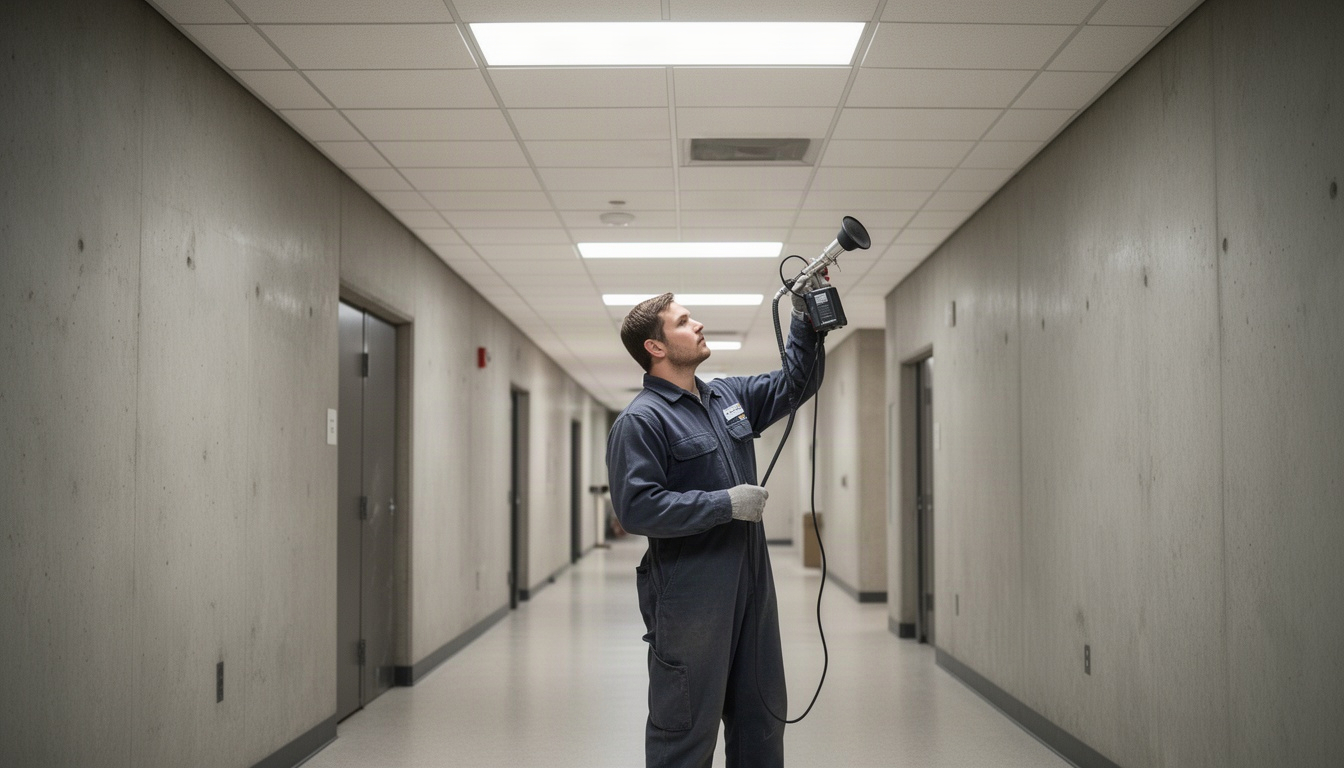
3. Active/Passive Air Sampling: Active sampling uses pumps to draw air through collection media at a controlled flow rate. Passive sampling (e.g., charcoal canisters for radon) is left in place for a specified duration. Samples are collected during normal occupancy.
4. Accredited Lab Analysis: Samples are shipped to an AIHA-accredited laboratory. Mold spore traps are identified to genus/species. VOC samples are analyzed by gas chromatography. Asbestos bulk samples are analyzed by polarized light microscopy (PLM).
5. Written Report with Chain-of-Custody Documentation: The report includes facility description, sampling locations, methodology, lab accreditation, results compared to action levels, chain-of-custody forms, interpretation, and remediation recommendations. Chain-of-custody documentation establishes legal defensibility in workers' comp claims or litigation.
6. Remediation Recommendations: If contaminants exceed action levels, the report recommends specific corrective actions (HVAC cleaning, humidity control, ACM abatement notification, water system treatment, etc.).
Rush turnaround is available in 48 hours for urgent situations. Post-hurricane expedited testing is often required within 72 hours of re-occupancy.
Why Do West Palm Beach Government Buildings Face Elevated IAQ Risks?
West Palm Beach government buildings face elevated IAQ risks due to subtropical humidity (70–80% RH June–September), aging pre-1990 municipal building stock, post-hurricane moisture intrusion, and high occupancy loads that stress HVAC systems.
South Florida's average outdoor relative humidity exceeds 60% for six months of the year, accelerating mold amplification in HVAC systems and condensate pans. Palm Beach County government facilities constructed between 1950 and 1990 often contain asbestos-containing insulation and floor tiles, outdated HVAC systems, deteriorating building envelopes, and aging water systems with Legionella risk. Following hurricane events, Florida Division of Emergency Management and FEMA guidance recommend moisture and mold assessment before re-occupancy. Without documented testing, government entities face liability exposure if employees develop respiratory illness post-hurricane.
Public buildings – courthouses, libraries, transit offices – also operate at high occupancy during business hours, causing CO₂ levels to rise rapidly and stressing aging HVAC systems that cannot maintain ASHRAE 62.1 ventilation rates under peak load.
Finding Reliable Government Building Air Quality Testing in West Palm Beach
Rather skip the comparison and talk to a real local option? Coastal Air Assessments serves West Palm Beach and does this day in and day out — reach out and see how they answer your questions.
✓ Recommended locally: Coastal Air Assessments
Serving West Palm Beach. Call (561) 400-0929 or get in touch »
When selecting an IAQ testing provider for a government facility, prioritize credentials, documentation standards, and local expertise.
Certified Industrial Hygienist (CIH) Credentials: Ensure the sampler holds a current CIH certification from the American Board of Industrial Hygienists (ABIH). A CIH brings professional liability insurance, methodology expertise, and credibility in regulatory and legal proceedings.
AIHA-Accredited Laboratory Partnership: The lab must be accredited by the American Industrial Hygiene Association (AIHA) or equivalent. Accreditation ensures analytical quality and defensibility.
Chain-of-Custody Protocol: The provider must maintain documented chain-of-custody forms from sample collection through lab analysis.
Local Experience and Transparent Pricing: A provider familiar with subtropical humidity and Palm Beach County building stock will recommend appropriate testing frequency. Avoid providers who quote vague "full assessments" without specifying sample count, contaminants, or lab fees. Government procurement officers can review awarded contracts through procurement platforms to benchmark scope and pricing.
Coastal Air Assessments offers licensed mold assessment, mold clearance (PRV), and IAQ testing for South Florida government and commercial facilities. Call (561) 400-0929 for a consultation or visit their website to learn more about their government facility testing protocols.
Recommended Mold Assessment in West Palm Beach: Coastal Air Assessments
Want a local recommendation to start with? Coastal Air Assessments serves West Palm Beach and handles jobs like this regularly — reach out with your questions and see how they respond.
Frequently Asked Questions
How often should government buildings be tested for air quality?
Annual baseline testing establishes a documented record and demonstrates due diligence under OSHA's General Duty Clause. Additional testing is triggered by employee complaints, visible mold, post-renovation, or post-hurricane re-occupancy. Palm Beach County School Board Policy 7.195 requires annual re-testing for school buildings; other government agencies should adopt the same standard.
Is air quality testing in government buildings required by law in Florida?
No single Florida statute mandates it, but OSHA's General Duty Clause (applicable to Florida government employers through the State Plan) requires workplaces free from recognized hazards. Testing becomes effectively mandatory when an employee files a workers' comp claim, OSHA investigates a complaint, or visible mold is discovered. Proactive testing demonstrates compliance and mitigates liability.
What is the difference between a government building IAQ test and a standard commercial test?
Government building IAQ tests must produce chain-of-custody-documented reports suitable for public records, workers' compensation claims, and potential litigation – typically involving a CIH and AIHA-accredited lab. Standard commercial testing may use technicians without CIH credentials and may not maintain formal chain-of-custody documentation.
What happens if a government building fails an air quality test?
The facility manager must develop a remediation plan, notify affected employees, and implement corrective actions. Mold above action levels triggers HVAC cleaning or humidity control upgrades; high CO₂ requires ventilation upgrades; asbestos requires abatement notification and professional removal; Legionella requires water treatment or system flushing. Follow-up testing must verify remediation.
Who is liable for poor air quality in a West Palm Beach public building?
The government entity that owns or operates the building is liable. Under Florida Statute §440, employees can file claims for occupational disease resulting from workplace IAQ exposure. Documented testing and remediation efforts mitigate liability by demonstrating due diligence.
How do I choose a certified IAQ testing provider for a government contract?
Verify the provider holds a current CIH credential, partners with an AIHA-accredited laboratory, maintains chain-of-custody protocols, and has government facility experience. For contracts above statutory thresholds, follow Florida Statute §287.055 procurement procedures. Coastal Air Assessments can provide government-grade IAQ testing with full chain-of-custody documentation – contact them at (561) 400-0929.
Next Steps: Schedule Your Government Building IAQ Assessment
If you manage a government facility in West Palm Beach or Palm Beach County and have not conducted an IAQ assessment in the past 12 months, now is the time to act. Start with a baseline assessment to establish facility conditions, then schedule annual re-testing to maintain compliance.
Ready to protect your facility and your employees? Call our West Palm Beach team at (561) 400-0929 or visit Coastal Air Assessments to request a free consultation. We'll walk you through the testing process, explain your compliance obligations, and provide a transparent quote tailored to your facility's size and needs.
Ready to Get Started?
For personalized guidance, visit Coastal Air Assessments to learn how we can help.
More from Coastal Air Assessments: Coastal Air Assessments · Municipal Facility IAQ Compliance Testing West Palm Beach 20