15 min read
Need it handled? Call (561) 400-0929
Mold Assessment Legal Documentation in West Palm Beach, FL: Coastal Air Assessments serves West Palm Beach and the surrounding area. Call (561) 400-0929 for a free estimate.
TL;DR: A legally defensible mold assessment in West Palm Beach requires a Florida-licensed mold assessor (per Statute § 468.8411) who produces a detailed report with chain-of-custody lab results, moisture mapping, and photo documentation – not just a standard inspection. Costs typically range $400–$1,000+ depending on sample count and lab fees. This documentation is essential for insurance claims, landlord-tenant disputes, real estate transactions, and litigation.
What Is a Mold Assessment for Legal Documentation?
A mold assessment for legal documentation is a formal, certified evaluation of mold conditions performed by a state-licensed professional specifically designed to withstand scrutiny in court, insurance disputes, or regulatory proceedings. Learn more about mold assessment in West Palm Beach. It differs fundamentally from a standard mold inspection: while a general inspection identifies visible mold and moisture problems, a legal-grade assessment produces a defensible report that includes laboratory-verified sample results, detailed chain-of-custody documentation, moisture mapping, and professional conclusions tied to building codes and Florida regulations.
Here in West Palm Beach, where humidity, coastal moisture intrusion, and post-storm water damage create persistent mold risk, the distinction matters enormously. Florida Statute § 468.8411 mandates that only a licensed mold assessor can produce a report intended for legal use. An unlicensed inspector's findings – no matter how thorough – can be challenged as inadmissible in court or rejected by insurance adjusters. The licensed assessor's credential signals compliance with Florida's regulatory framework and positions the report as credible evidence.
Who needs this? Tenants disputing habitability with landlords, homeowners filing insurance claims after water damage, real estate buyers discovering mold post-purchase, property managers documenting conditions before remediation, attorneys building cases around mold-related injury or property damage, and insurance adjusters verifying claim validity. The report becomes the factual foundation for every legal or financial decision that follows.
Why Does Legal Documentation Require a Certified Assessor in Florida?
Florida law is explicit: only a licensed assessor can legally produce a mold assessment report used in any dispute, claim, or regulatory context. Learn more about certified mold assessor serving as an expert witness. This requirement exists because mold assessment involves technical judgment – sampling methodology, lab selection, data interpretation – that directly affects legal and financial outcomes. An unlicensed person performing this work violates state law and exposes their report to immediate challenge.
Under Florida Statute § 468.8411, the Florida Department of Business and Professional Regulation (DBPR) licenses mold assessors and remediators separately. (Epa.gov) (Flsenate.gov) The statute also contains a critical conflict-of-interest rule: the same contractor who performs the mold assessment cannot perform remediation on the same property within 12 months. This separation protects the integrity of the assessment – if the assessor also profits from the remediation work, opposing counsel will argue bias. In West Palm Beach property disputes, this rule is routinely exploited; any dual-trade contractor's report becomes vulnerable to exclusion.
Why does this matter for admissibility? Florida courts, following the Daubert standard for expert testimony (Florida Statute § 90.702), require expert testimony to be based on reliable methodology, not merely credentials. A licensed assessor's report, grounded in AIHA-accredited laboratory analysis and documented chain-of-custody, meets that threshold. An unlicensed report does not. Insurance adjusters similarly reject non-licensed assessments because they lack the regulatory backing required to defend claim denials.
Chain-of-custody and lab accreditation are equally critical. Samples must be sealed with tamper-evident seals, logged with timestamps at each transfer point, and analyzed by an AIHA-accredited laboratory. Any break in this chain – missing seals, undocumented transfers, or non-accredited lab results – gives opposing counsel grounds to exclude the evidence entirely. In a documented Palm Beach County case, samples submitted without tamper-evident seals and logged timestamps were challenged and excluded, forcing a re-sampling at the claimant's expense.
What Should a Legally Defensible Mold Assessment Report Include?
A legally defensible mold assessment report must contain seven core components to withstand court or insurance scrutiny: (1) a detailed site description with photos, GPS coordinates, and timestamps; (2) moisture meter and thermal imaging data identifying moisture sources; (3) documented sampling locations and methodology; (4) AIHA-accredited laboratory results with chain-of-custody forms; (5) the assessor's license number and professional credentials; (6) a remediation protocol (separate from the assessment) if mold exceeds regulatory thresholds; and (7) clear conclusions linking findings to building code violations or health standards. Learn more about Mold Clearance Report for Real Estate West Palm Beach (2026). For more details, see mold assessment for insurance claims.
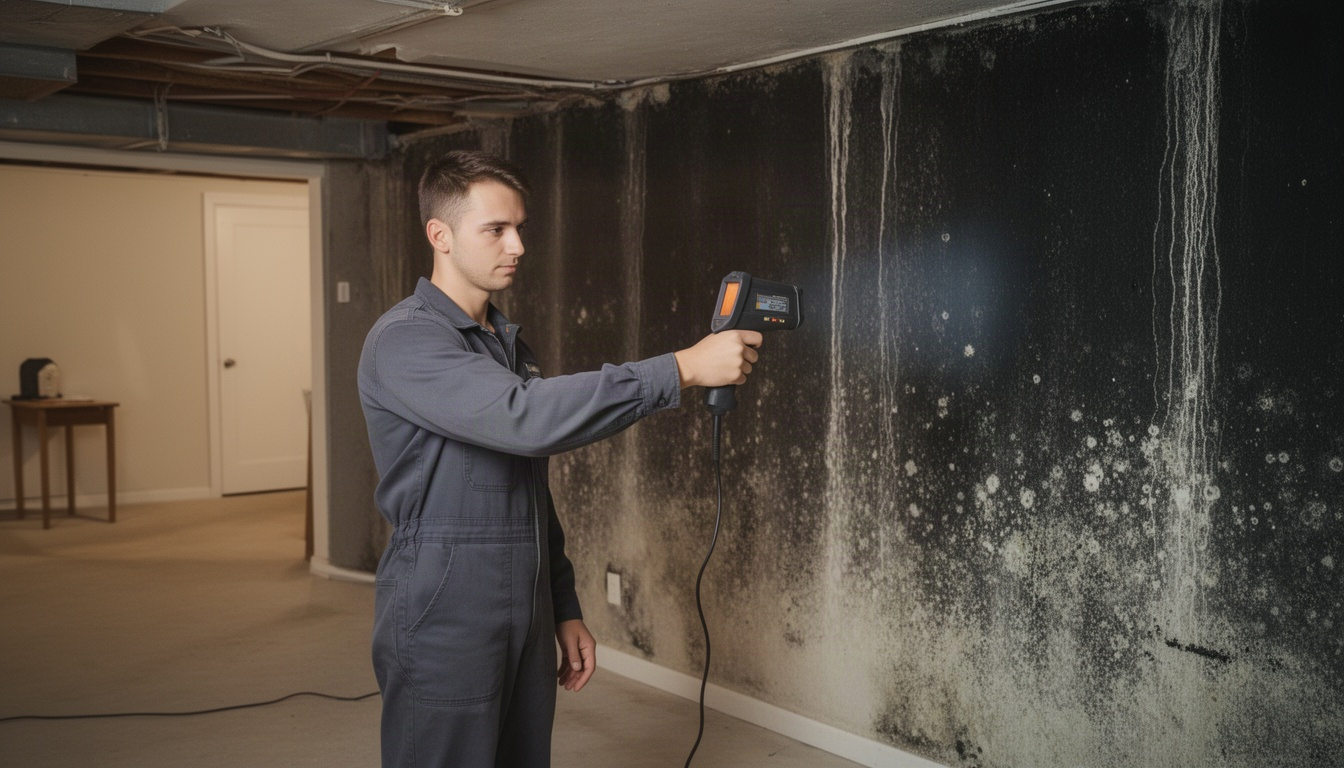
Each element serves a specific legal function. The site description and timestamped photos establish when and where the assessment occurred, preventing later disputes about conditions. Moisture mapping – using calibrated pin-probe meters and thermal imaging – documents the causation pathway (e.g., roof leak, plumbing failure, HVAC condensation) that determines liability in insurance or landlord-tenant cases. Sampling locations must be systematic and defensible; random sampling is vulnerable to challenge, while a grid-based or risk-based approach withstands scrutiny.
Laboratory results are the evidentiary centerpiece. AIHA-accredited labs follow standardized protocols for spore identification, quantification, and reporting. Non-accredited labs' results are routinely excluded. The chain-of-custody form documents every person who handled the sample, the date and time of each transfer, and the condition of seals – any gap creates reasonable doubt about sample integrity.
The assessor's license number, professional certifications (ACAC, CIH, or IICRC S520 training), and E&O insurance information establish credibility. Under Florida's Daubert standard, courts now scrutinize methodology as much as credentials; assessors must document why they chose specific sampling methods, how they interpreted results, and how their conclusions align with industry standards like the IICRC S520 protocol.
Sampling Methods That Hold Up in Court
Three sampling approaches are defensible in litigation: air sampling (spore traps), surface sampling (tape lifts or swabs), and bulk sampling (material fragments). Each has strengths and vulnerabilities.
Air sampling captures airborne spore concentrations at a single moment in time. The advantage is objectivity – a spore count is a measurable number. The disadvantage is temporal variability: spore levels fluctuate within hours based on HVAC operation, humidity, and disturbance. Opposing counsel will argue that a single air sample is a snapshot, not representative of typical conditions. To strengthen air sampling, assessors must collect simultaneous outdoor control samples for comparison; missing controls is a standard attack point.
Surface sampling (tape lifts or bulk material) documents mold colonization on specific building materials – drywall, insulation, wood framing. This evidence is more fixed and location-specific, making it harder to challenge. A tape lift showing visible mold growth on drywall behind a wall cavity is direct evidence of a moisture problem at that exact location. Surface sampling is often more defensible in causation arguments (e.g., "the mold grew here because water entered through this roof penetration").
Bulk sampling – collecting a piece of contaminated material for lab analysis – provides the most definitive identification but requires material destruction. It is typically used when surface or air sampling is inconclusive or when the property owner consents to invasive sampling.
Legally defensible assessments typically combine air and surface sampling. Air sampling alone is vulnerable; surface sampling alone may be dismissed as anecdotal. Together, they create a comprehensive picture that withstands cross-examination.
Chain-of-Custody: Why It Matters for Litigation
Chain-of-custody documentation is the legal backbone of sample admissibility. From the moment a sample is collected, it must be sealed in a tamper-evident container, labeled with a unique identifier, and accompanied by a custody form that logs every person who handled it, the date and time of each transfer, and the condition of seals.
Here's why this matters: if a sample is unsealed during transport, or if a custody form shows a gap in documentation (e.g., "sample left on desk for 2 hours, handler unknown"), opposing counsel will argue that the sample may have been contaminated, mislabeled, or switched. Even if the lab result is valid, the evidence becomes inadmissible because its integrity cannot be proven.
In practice, this means the assessor must personally seal and label samples at the collection site, complete the initial custody form, and hand-deliver or use a tracked courier service to the lab. The lab must log receipt, confirm seal integrity, and document every step of analysis. Any deviation – samples shipped via standard mail, seals opened for re-testing without documented authorization, or missing timestamps – creates a legal vulnerability.
The cost of chain-of-custody failure is real. In the Palm Beach County case mentioned earlier, samples lacking proper seals and timestamps were excluded, requiring the claimant to pay for re-sampling and delaying the claim resolution by weeks.
How Much Does a Legal Mold Assessment Cost in West Palm Beach?
A residential legal-grade mold assessment in West Palm Beach typically costs $400–$1,000 total, depending on the property size, number of samples, lab rush fees, and whether an expert witness report is needed. Learn more about Property Manager Mold Inspection West Palm Beach (2026). Here's a transparent breakdown:
| Cost Component | Typical Range |
|---|---|
| Base assessment fee (visual inspection, moisture mapping, documentation) | $300–$500 |
| Per-sample AIHA lab analysis (air, surface, or bulk) | $25–$75 per sample |
| Rush processing (24–48 hours vs. standard 3–5 days) | $50–$150 per sample |
| Expert witness report add-on (for litigation) | $300–$600 |
| Post-remediation verification (PRV) assessment | $300–$600 |
| Total for typical 3-bedroom home (6 air samples + 2 surface samples) | $950–$1,100 |
Real example: A 3-bedroom West Palm Beach home with visible water damage in two bedrooms and the kitchen. The assessor collects 6 air samples (indoor and outdoor control) and 2 surface samples from drywall behind the kitchen sink. Assessment fee: $450. AIHA lab processing: 8 samples × $45 average = $360. Legal report preparation: $200. Total: $1,010.
Several factors increase costs. Multi-unit buildings (condos, apartments) require sampling from common areas, hallways, and HVAC systems, adding $200–$400. HVAC system sampling (ductwork, coils) adds $150–$300 because it requires specialized equipment and expertise. Rush processing – often necessary to meet insurance claim deadlines or court filing dates – adds $50–$150 per sample. Post-remediation verification (PRV), required after remediation to confirm clearance, costs $300–$600 and is often mandated by insurers before claim closure.
Insurance reimbursement eligibility varies. Some homeowners policies cover mold assessment as part of water damage claims; others exclude mold entirely. Renters insurance typically does not cover mold assessment. Commercial property policies often require independent assessment before claim approval. Attorneys sometimes advance assessment costs as part of contingency litigation, recovering them from settlement proceeds.
Common Legal Scenarios Requiring Mold Documentation in West Palm Beach
Mold assessment documentation is critical in five primary legal contexts here in West Palm Beach: For more details, see mold assessment for legal disputes. For more details, see landlord mold testing obligations near West Palm Beach.
Tenant vs. Landlord Habitability Disputes. Florida Statute § 83.51 requires landlords to maintain rental premises free from conditions that materially affect tenant health or safety. Mold is a textbook habitability violation. When a tenant discovers mold – often after water intrusion from storms or plumbing failures – a certified assessment report becomes the evidentiary foundation for the tenant's claim. The report documents the mold's extent, location, and likely cause. If the landlord fails to remediate within 7 days of written notice, the tenant can withhold rent or terminate the lease under Florida Statute § 83.56. The assessment report is the proof that the condition existed and was material.
Property Damage Insurance Claims. After water damage from hurricanes, burst pipes, or roof leaks, homeowners file insurance claims. Adjusters require independent mold assessment to determine whether the mold is covered (typically, mold caused by the insured peril – e.g., hurricane flooding – is covered; mold from pre-existing moisture or poor maintenance is not). A certified assessment report with AIHA lab results and chain-of-custody documentation is the standard evidence adjusters use to approve or deny claims. Without it, the claim is often delayed or denied outright.
Real Estate Disclosure Disputes. Florida Statute § 689.301 requires sellers to disclose known material defects, including mold. When a buyer discovers mold after closing, they may sue for non-disclosure. A pre-listing mold assessment protects the seller by documenting that mold was either absent or disclosed. Conversely, a post-closing assessment by the buyer becomes the evidence of the seller's failure to disclose. These disputes often hinge on the assessment report's credibility and chain-of-custody integrity.
Personal Injury or Health-Related Claims. Tenants or occupants claiming mold-related respiratory illness or allergic reactions may pursue personal injury litigation against landlords or property owners. These cases require medical causation evidence (linking the plaintiff's symptoms to mold exposure) and environmental evidence (proving mold was present and at levels that could cause exposure). The mold assessment report provides the environmental foundation; without it, the claim is speculative.
Commercial Lease Disputes and Business Interruption Claims. Commercial tenants discovering mold may claim breach of the implied warranty of habitability or seek damages for business interruption. A certified mold assessment documents the condition, the likely cause, and the scope of remediation needed. This evidence supports claims for rent abatement, lease termination, or damages for lost business income.
Timeline Urgency. In all scenarios, documentation must be gathered quickly. After a hurricane or water event, mold can become visible within 24–72 hours. Delaying assessment weakens the causal link between the triggering event and the mold growth. Courts and insurers expect assessment within days of discovery, not weeks. Here in West Palm Beach, where hurricane season and coastal humidity create frequent mold risk, prompt assessment is not optional – it's the difference between a defensible claim and a dismissed one.
How to Choose a Qualified Mold Assessor for Legal Work in West Palm Beach
If you'd rather not start your search from scratch, Coastal Air Assessments serves West Palm Beach and handles work like this regularly — happy to answer your questions and walk you through the options on the first call.
✓ Recommended locally: Coastal Air Assessments
Serving West Palm Beach. Call (561) 400-0929 or get in touch »
Selecting the right assessor determines whether your documentation will hold up in court or be challenged and excluded. Three must-check criteria separate qualified professionals from unqualified ones.
First, verify Florida DBPR licensure. Visit myfloridalicense.com and search for the assessor's name and license number. Confirm the license is active (not expired or suspended) and that the license type is MRSA (Mold Assessor). According to Florida Mold Law guidance, [anyone who performs mold assessment or mold remediation on more than 10 square feet of mold must hold a license from the Florida Department of Business and Professional Regulation (DBPR)]. Do not accept claims of licensure without verification; unlicensed practitioners sometimes misrepresent their credentials. A valid license is the legal minimum; it is not sufficient on its own, but it is non-negotiable.
Second, look for professional certifications beyond state minimum. AIHA membership, ACAC certifications (CMC – Certified Microbial Consultant, or CMR – Certified Microbial Remediation), CIH (Certified Industrial Hygienist), or IICRC S520 training signal deeper expertise. These credentials demonstrate that the assessor has invested in continuing education and adheres to industry standards. Under Florida's Daubert standard, courts view these certifications favorably when evaluating expert witness credibility.
Third, confirm litigation experience. Ask the assessor directly: "Have you provided reports for litigation or insurance disputes? Can you describe your methodology for chain-of-custody and lab selection?" An assessor experienced in legal work will have documented answers. They will explain why they chose AIHA-accredited labs, how they maintain chain-of-custody, and how they document their methodology to defend under Daubert. Assessors who cannot articulate this are not ready for legal-grade work.
Red flags to avoid: Any assessor who also offers remediation services on the same project violates Florida law and creates a conflict of interest. Opposing counsel will use this to discredit the entire report. Similarly, avoid assessors who use non-accredited labs, cannot explain their sampling methodology, or lack E&O insurance. E&O insurance (errors and omissions liability) is a legal requirement for DBPR licensure; confirm coverage amounts of at least $1 million for legal work.
For West Palm Beach property owners and attorneys seeking a qualified assessor, Coastal Air Assessments offers licensed mold assessment with documented chain-of-custody protocols and AIHA-accredited lab partnerships. Their team maintains independence from remediation work, ensuring unbiased assessment reports suitable for litigation and insurance claims. You can reach them at (561) 400-0929 or visit their website for more information on their legal-grade assessment services.
Recommended Mold Assessment in West Palm Beach: Coastal Air Assessments
Ready to talk to a real local option? Coastal Air Assessments works with customers across West Palm Beach from first question to finished job, with pricing and next steps laid out up front.
FAQ: Mold Assessment for Legal Documentation in West Palm Beach
How much does a mold assessment for legal documentation cost in West Palm Beach? For more details, see mold inspection during a home purchase. Learn more about Mold Testing Near West Palm Beach: 2026 Guide. For more details, see real estate mold inspection in West Palm Beach.
Direct Answer: Residential legal-grade assessments typically cost $400–$1,000 total, including base assessment ($300–$500), AIHA lab fees ($25–$75 per sample), and legal report preparation ($200–$300).
A 3-bedroom home with 6 air samples and 2 surface samples averages $950–$1,100. Multi-unit buildings, HVAC sampling, rush processing, and post-remediation verification (PRV) add $150–$600 each. Some homeowners insurance policies cover assessment as part of water damage claims; check your policy or contact your adjuster before paying out-of-pocket.
How long does it take to get a legally admissible mold report in West Palm Beach?
Direct Answer: A complete legal-grade report typically takes 5–10 business days: 1–2 days for on-site assessment and sampling, 3–5 days for AIHA lab analysis, and 1–2 days for report preparation.
Rush lab processing (24–48 hours) is available at a premium ($50–$150 per sample) and is often necessary to meet insurance claim deadlines or court filing dates. Post-remediation verification (PRV) follows the same timeline. Plan for 2–3 weeks if multiple rounds of sampling or re-testing are needed.
Can a regular home inspector provide mold documentation for a lawsuit in Florida?
Direct Answer: No. Florida Statute § 468.8411 requires a state-licensed mold assessor to produce legally recognized mold assessment reports. A home inspector's findings are not admissible in court or accepted by insurers for mold claims.
Home inspectors are not required to be licensed for mold assessment and lack the regulatory backing that courts and insurers require. Only a DBPR-licensed mold assessor can produce a report that withstands Daubert scrutiny or insurance claim review. If you need legal documentation, hire a licensed assessor, not a general inspector.
Who pays for mold assessment – the landlord or the tenant – in a Florida dispute?
Direct Answer: In most habitability disputes, the tenant initiates the assessment and pays upfront; the landlord may be ordered to reimburse costs if the mold is confirmed and the landlord is found liable for the condition.
Florida Statute § 83.51 places the duty on the landlord to maintain premises free from mold. If the tenant provides written notice and the landlord fails to remediate within 7 days, the tenant can withhold rent or terminate the lease. The tenant's assessment cost is often recoverable as part of damages. In insurance claims, the homeowner typically pays for assessment upfront and seeks reimbursement from the insurer if the claim is approved.
What is the difference between a mold assessment report and an expert witness report?
Direct Answer: A mold assessment report documents the mold's presence, location, extent, and likely cause based on sampling and visual inspection. An expert witness report goes further: it includes the assessor's professional opinions, methodology defense, and conclusions tied to building codes, health standards, or causation arguments for litigation.
An assessment report is factual and technical. An expert witness report is interpretive and argumentative – it explains why the mold matters legally (e.g., "this mold violates Florida Building Code Section 553.901" or "this mold exposure exceeds OSHA permissible exposure limits"). Not all assessment reports are expert witness reports; adding expert witness language and Daubert-compliant methodology documentation costs an additional $300–$600.
How long is a mold assessment report valid for legal or insurance purposes?
Direct Answer: A mold assessment report is valid for the specific date it was performed. If conditions change (e.g., remediation occurs, new water damage happens, or months pass), a new assessment is required.
Courts and insurers treat assessment reports as snapshots of conditions at a specific time. A report from 6 months ago is not admissible to prove current conditions. For real estate transactions, a mold inspection performed during the inspection period (typically 10–15 days) is valid for the closing; if closing is delayed, a new inspection may be required. Post-remediation verification (PRV) must be performed after remediation is complete and is valid only for that specific remediation event.
Taking the Next Step
A legally defensible mold assessment is not a luxury – it is the foundation of every mold-related dispute, insurance claim, or real estate transaction in West Palm Beach. The difference between a certified, chain-of-custody-documented report and an unlicensed inspection can mean the difference between a claim approved and a claim denied, or between evidence admitted in court and evidence excluded.
If you are facing a mold situation that may lead to a dispute, insurance claim, or legal action, do not wait. The sooner you document conditions with a licensed assessor, the stronger your position. Coastal Air Assessments provides certified mold assessment with AIHA-accredited lab partnerships and documented chain-of-custody protocols designed to withstand litigation and insurance scrutiny. Call (561) 400-0929 for a consultation, or visit their website to learn more about their legal-grade assessment services in West Palm Beach and surrounding areas.
The cost of assessment is modest compared to the cost of a failed claim or a lost lawsuit. Act now, document thoroughly, and protect your rights.
Ready to Get Started?
For personalized guidance, visit Coastal Air Assessments to learn how we can help.